
A comprehensive global study led by researchers at Sun Yat-sen University and with the participation of Giovanni Forzieri from the Department of Civil and Environmental Engineering of the University of Florence has revealed critical insights into how different forest management practices affect forest resilience under varying environmental conditions. The findings, published in a high-profile scientific journal (Nature Communications, https://doi.org/10.1038/s41467-026-69598-4), provide essential guidance for policymakers and forest managers worldwide as they work to protect forests in an era of climate change.
Major Findings:
The study, which analyzed global forest data from 2001 to 2015 using advanced satellite observations and machine learning techniques, found that:
(1) Natural forests without human management demonstrate the highest resilience among all forest types, exhibiting approximately 20% greater resilience than human-established plantations.
(2) Forest management practices generally weaken resilience, particularly under intensive anthropogenic pressures, affecting critical regions such as the Amazon rainforest and Central Africa.
(3) However, the research identified a crucial threshold: in wet climates where the ratio of precipitation to potential evapotranspiration exceeds 1.5, planted forests can exhibit higher resilience than natural forests.
(4) Cold temperatures, dense vegetation, and high soil fertility can enhance the resilience of managed forests to levels approaching those of natural forests.
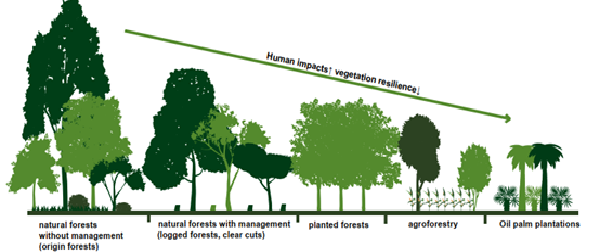
Different forest management types
"This research provides groundbreaking evidence that forest management decisions must be tailored to local environmental conditions," said Dr. Zhiyong Liu, corresponding author from the Center for Water Resources and Environment at Sun Yat-sen University. "Our findings show that in certain biophysical contexts, well-designed planted forests can match or even exceed the resilience of natural forests, challenging conventional assumptions about forest management."
The findings have significant implications for global forest management and climate policy. With planted forests expanding at an annual rate of 1.8% and expected to continue growing until 2050, understanding how to maximize their resilience is crucial for achieving international climate targets, including the European Green Deal, the UN Decade on Ecosystem Restoration (2021-2030), and the Kunming-Montreal Global Biodiversity Framework.
Yu Yan from Sun Yat-sen University, a co-author of the study, emphasized: "As forests face increasing threats from climate-driven disturbances such as droughts and wildfires, our research provides a science-based framework for designing afforestation programs that carefully consider local biophysical contexts to mitigate the negative effects of human pressure on forest resilience."
The study was conducted by an international team of researchers from China, Singapore, and Italy. It was supported by the National Natural Science Foundation of China, the Natural Science Foundation of Guangdong Province, the European Union's Horizon Europe program (ClimTip project), and other funding agencies.